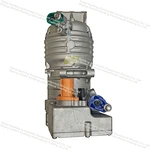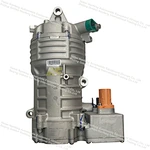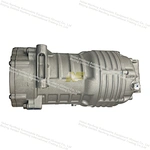
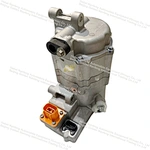
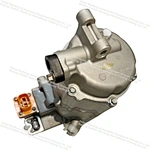
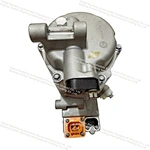
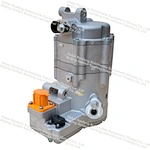
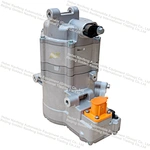
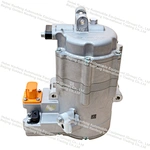
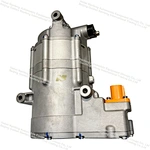
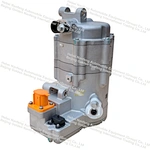
Electric Bus Air Conditioning Compressor
NF E46_630V
The commercial vehicle electric air conditioning compressor is the “cooling heart” of the air conditioning system for electric trucks and buses. Its core is to be independently driven from the engine and provide continuous and stable refrigerant compression power to the air conditioning system through motor and frequency conversion control. It is compatible with the architecture of new energy commercial vehicles, balancing refrigeration efficiency, energy saving, and reliability. It can also cooperate with battery thermal management and is the core component of commercial vehicle air conditioning systems.
Quantity:
The electric air conditioning compressor is the core component of an electric vehicle's air conditioning system. Its working principle involves using an electric motor to compress a low-temperature, low-pressure gaseous refrigerant into a high-temperature, high-pressure gas, propelling the refrigerant through a closed system to achieve cooling (or heating) inside the vehicle.
Its core workflow follows a refrigeration cycle of"compression-condensation-expansion-evaporation":
1. Compression: The electric motor drives the rotor (such as a scroll plate or piston) inside the compressor to compress the low-temperature, low-pressure refrigerant gas drawn from the evaporator, significantly increasing its temperature and pressure, transforming it into a high-temperature, high-pressure gaseous refrigerant.
2. Condensation: The high-temperature, high-pressure gaseous refrigerant is transported to the condenser outside the vehicle. Here, the refrigerant releases heat to the outside air, cooling and liquefying into a high-pressure liquid.
3. Expansion: The high-pressure liquid refrigerant flows through an expansion valve (or throttle valve), where its pressure and temperature drop sharply, becoming a low-temperature, low-pressure mist-like liquid.
4. Evaporation: Low-temperature, low-pressure liquid refrigerant enters the evaporator inside the vehicle, absorbs heat from the air flowing through it, and evaporates into a low-temperature, low-pressure gas. This process lowers the temperature of the air inside the vehicle, achieving a cooling effect.
5. Circulation: The evaporated low-temperature, low-pressure gaseous refrigerant is drawn back into the compressor, beginning a new cycle.
Model | NF46_630V |
Type | Electric scroll |
Refrigerant | R134a / R1234-yf |
| Displacement | 46 cm³/rev |
Speed range | 800-11000RPM |
Refrigerant Oil/Oil Volume | POE RB68/150mll |
HV Rated Voltage | 630V(DC) |
LV Rated Voltage | 24VDC |