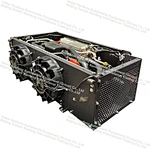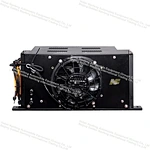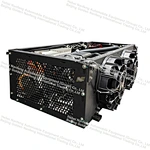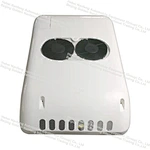
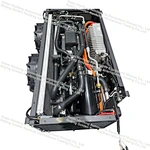
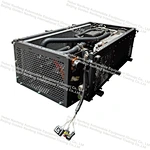
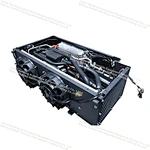
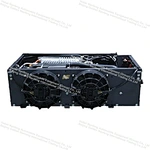
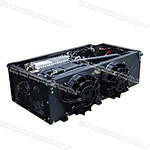
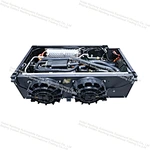
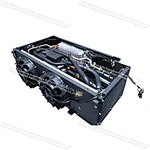
10kW Battery Thermal Management System
NF BTM1504
NF Battery Thermal Management Systems are designed to regulate battery coolant temperature across different electric vehicle operating conditions.
By integrating refrigeration cooling, coolant circulation, intelligent control and optional or integrated heating functions depending on the model, our BTMS solutions support stable battery thermal management and vehicle-level system integration.
Multiple cooling capacities are available to match different battery thermal loads, voltage platforms and vehicle applications.
Quantity:
NF Battery Thermal Management can be used in EV Heavy Equipment. Cities need construction sites to cope with the constant changes being made to meet the latest standards. See construction vehicles are a common and almost daily part of urban life. Construction machinery such as excavators are indispensable in order to complete reconstruction work as quickly as possible. They transport heavy loads on a daily basis and therefore work harder than ordinary vehicles. However, a large amount of fuel is consumed, which increases CO2 emissions. With this in mind, purely electric vehicles are the best way to protect the climate and save costs, while also advancing the modernization of cities.

Technical Parameter
| Product Name | 10kW /15KW Optional |
| Product Model Code | NFBTM10 |
| Refrigeration Capacity Test Condition | Ambient temperature 38ºC, outlet water temperature constant at 15ºC |
| Operating Ambient Temperature | -30 to +60ºC Refrigeration condition: -15ºC to +55ºC |
| Maximum Cooling Capacity | 10KW(8~24KW) (Optional) |
| Maximum Heating Capacity | 0~35Kw |
| Compressor Displacement | 33CC/46CC |
| Compressor Speed | 800~10000rpm/800~12000rpm |
| Coolant Type | 50%/50% Ethylene Glycol/Water Solution |
| Refrigerant Type | R134a |
| Communication Interface | CAN 2.0 Communication Rate: 500k bps |
| Control Method | Operating Mode + Target Water Temperature |
| COP | >2.2 |
| Coolant Flow Rate | >35L/min @ External Resistance 110kPa |
| Noise Level | <80dB (A) @ Maximum |
| Protection Rating | IP67 |
| Weight | <48kg/76KG |
| Low-voltage Power Supply Operating Range | 18~32V |
| High-voltage Power Supply Operating Range | ≤750V |
| Dimensions | L833W550H290mm/L900*W608*H341mm(excluding standard parts) |
| Inlet/Outlet Pipe Installation Diameter | Diameter 25mm |
Battery thermal management devices are appropriate for a variety of electric vehicles, including electric cars, electric bicycles, and so on. The temperature of the battery in these cars frequently influences its performance and life. As a result, the installation of battery thermal management systems can effectively reduce battery temperature, lengthen vehicle service time, and improve vehicle performance.
Introduction:
The vehicle-grade battery cooling unit covers a cooling capacity of 8-15KW and a heating capacity of 10-24KW, providing battery cooling/heating for commercial vehicles (new energy heavy-duty trucks, new energy buses, new energy construction machinery), energy storage stations, battery swap stations, and other large-capacity battery applications
Detailed Photos

High-Temperature Heat Dissipation: Quickly dissipates heat during fast charging and high-power discharging, preventing overheating, thermal runaway, and lifespan degradation.
Low-Temperature Preheating: Rapidly warms up during winter/cold starts, improving charging and discharging efficiency and avoiding the risks of lithium dendrite formation and internal short circuits.
Temperature Uniformity: Suppresses localized hot spots, reducing uneven cell aging.
Safety and Lifespan Assurance: Extends cycle life and reduces the probability of thermal runaway through temperature control.
Energy Optimization: Recovers waste heat from the motor/electronic control system, improving winter range.